
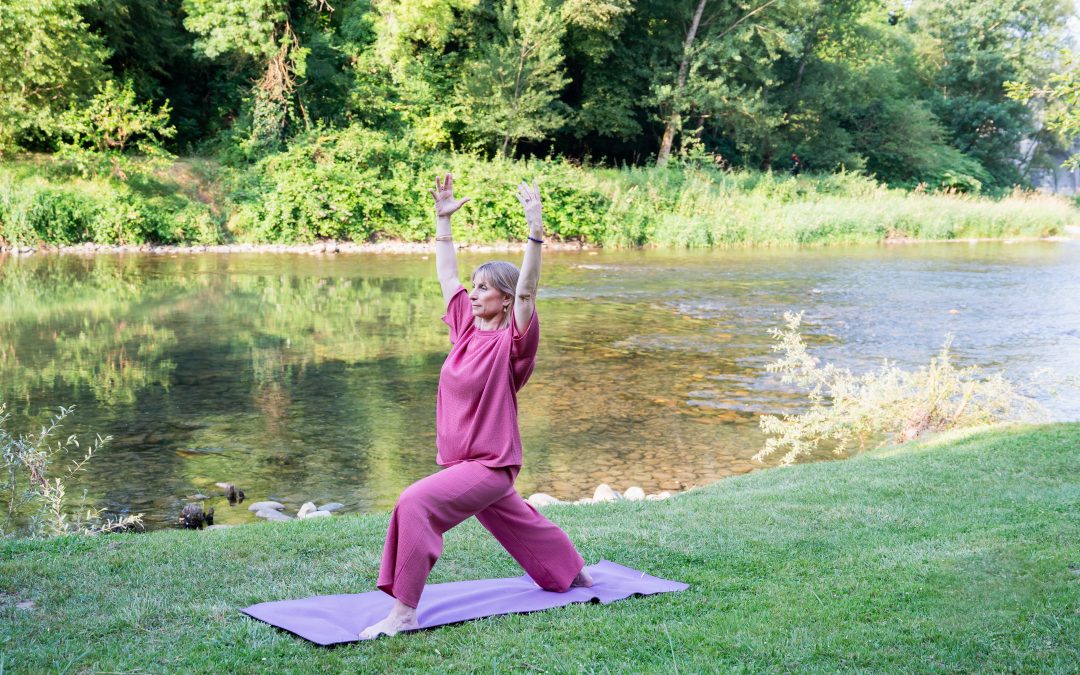
Menopause can change the way we feel in our bodies.
Sometimes quite suddenly.
Sleep may become more difficult. We may feel more tired, more stressed or less comfortable in a body that seems to be changing without asking our permission. Joints can feel stiffer, muscle strength may decrease, and things that used to work for us may not feel quite right anymore.
This is often when women ask me whether yoga can help during menopause.
My answer is yes, but perhaps not for the reasons you might expect.
Yoga cannot stop menopause, and I don’t believe we should present it as a solution for every symptom. But it can be a very useful way to support the body and mind through this transition.
And after many years of teaching yoga, I also think the way we practise matters.
I have been teaching yoga for around 15 years, and one of the interesting things is that my own way of practising has changed with me.
When I was younger, I probably paid more attention to flexibility and to what my body could do in a pose. Today, I think much more about what I want my body to still be able to do in ten or twenty years.
I want to stay strong. I want to keep good balance. I want to get down onto the floor and back up easily. I want to walk, travel and keep doing the things I enjoy.
So my yoga practice has changed too.
Menopause has made me look at yoga less as a way of “doing poses” and more as one part of taking care of my future body.
Menopause may be a time to practise differently
I still love yoga for many of the same reasons I always have: the movement, the breathing, the feeling of being more present in my body.
But today I am less interested in how far I can go into a pose.
I am much more interested in what my body needs to keep doing well.
Can I stay mobile? Can I keep my balance? Can I maintain my strength? Can I move without fear and feel confident in my body?
For me, yoga during menopause and after 50 is not about becoming more and more flexible.
It is about keeping the body capable.
That is quite a different goal.
Yoga can give us space when life feels stressful
Stress is one of the things that comes up again and again when I speak to women during perimenopause and menopause.
And it is not always simply because of hormones.
Midlife can already be a very full period of life. Work, family, ageing parents, relationships, changing roles, there can be a lot going on at the same time.
Add poor sleep or uncomfortable menopause symptoms and we can sometimes feel as if our nervous system never really switches off.
This is one of the areas where I find yoga particularly helpful.
Slower movement, breathing practices and relaxation give us an opportunity to stop doing for a moment.
Not to achieve anything.
Just to slow down.
I often see the difference at the end of a class. Faces are softer. Shoulders have dropped. Breathing is slower.
Over the years, women have sometimes come to class tired, stressed or after a difficult day and told me afterwards, “I really needed that today.”
For me, this is also part of yoga.
We don’t always need to measure its value by how flexible we have become or how difficult a pose we can do. Sometimes the benefit is simply leaving the mat feeling a little better than when we arrived.
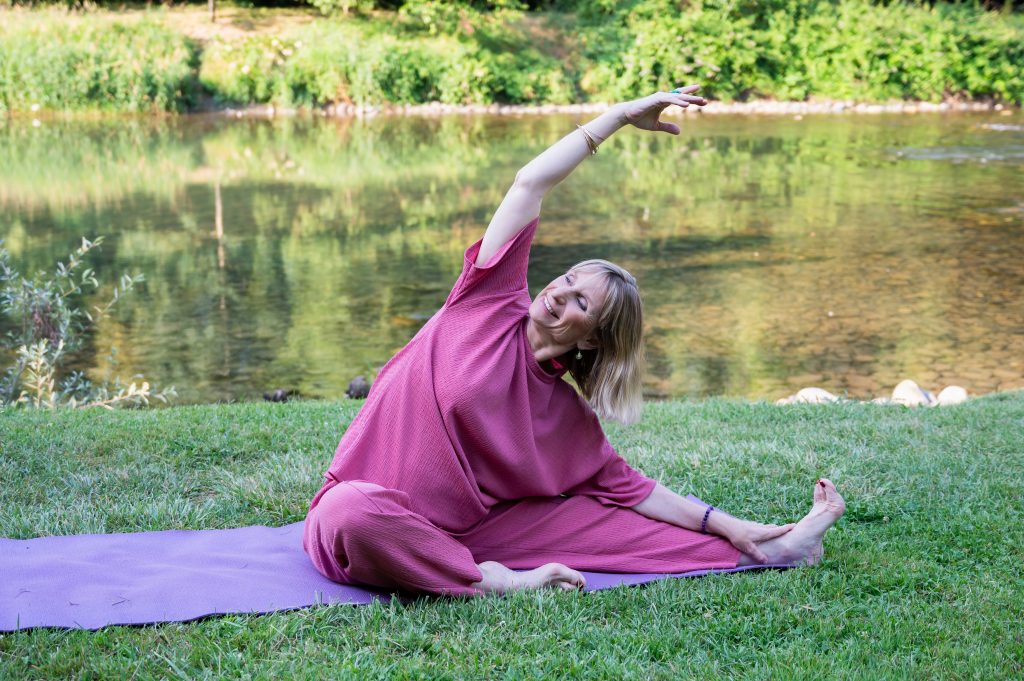
What does research tell us about yoga and menopause?
Research is beginning to support some of what many women experience in practice.
A recent systematic review and meta-analysis looked at 24 studies involving more than 2,000 women. It found that yoga may help with several menopause-related symptoms, including psychological symptoms, anxiety and sleep.
But the results were not positive for everything. For example, the review did not find a significant effect on hot flushes.
I think this is important to say.
Yoga can be a very useful support during menopause, but it is not a treatment for every symptom and I don’t like presenting it as a miracle solution.
What about sleep?
Many women discover during perimenopause that sleep is no longer something they can take for granted.
They may struggle to fall asleep, wake during the night or simply wake up feeling as if they have not really rested.
Yoga is not a magic answer to insomnia.
But gentle yoga, breathing and relaxation can be useful ways to prepare the body for rest, particularly when stress and tension are part of the picture.
This is why I don’t think every yoga practice needs to be physically challenging.
Sometimes what a woman needs from yoga is movement.
Sometimes she needs strength.
And sometimes she needs to lie down, breathe and let her body become quiet.
Learning to recognise the difference is part of the practice too.
We still need strength
This is something I talk about much more now than I did when I first started teaching yoga.
As women get older, maintaining muscle becomes increasingly important. Menopause is also a time when we need to pay more attention to our bones.
NICE, the UK’s National Institute for Health and Care Excellence, specifically recommends explaining to women going through menopause the importance of maintaining muscle mass and strength through physical activity.
Yoga can contribute to strength. Many poses ask us to support our own body weight, stabilise joints and use muscles in a controlled way.
But I also think it is important to be clear about its limits.
Yoga is part of my movement routine, but it is not the only thing I do.
I walk and I do strength training too.
For me, these things complement each other beautifully.
Yoga gives me mobility, balance, body awareness and some strength. Strength training allows me to challenge my muscles more progressively. Walking keeps me moving and gets me outside.
I don’t think women need to choose between them.
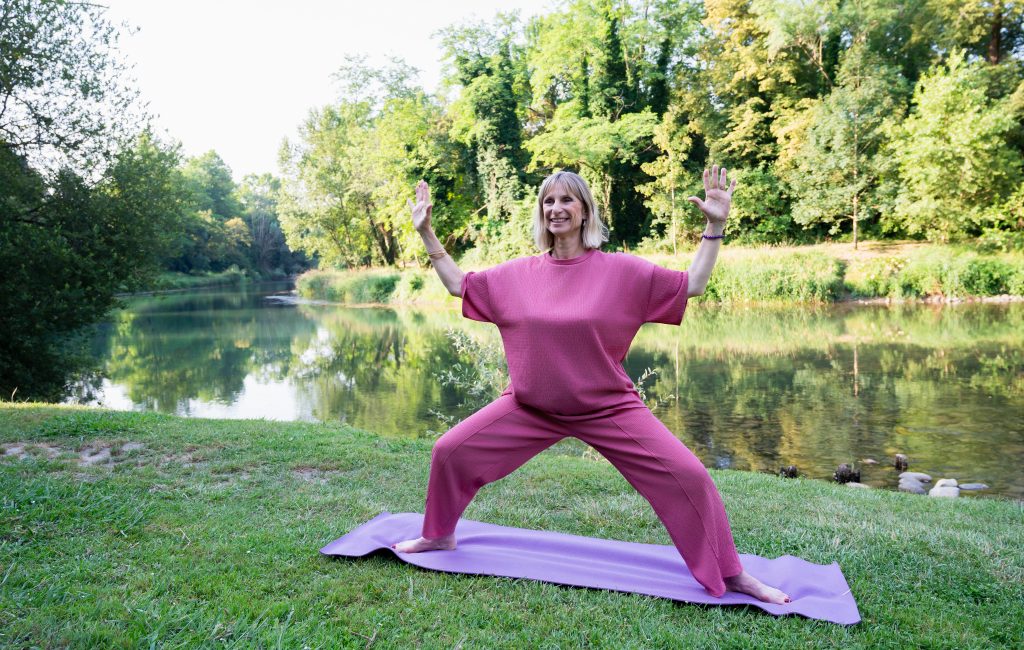
Balance becomes important too
Balance is something we often don’t think about until it becomes more difficult.
Yoga gives us many opportunities to practise it.
Standing on one leg sounds very simple — until you try it!
Balance poses ask the feet, legs, core, eyes and nervous system to work together. They also teach us how to respond when we wobble.
And wobbling is not failing.
It is part of the work.
As I get older, I see balance less as a yoga skill and more as something I want to keep for everyday life.
Yoga can help us stay mobile without forcing flexibility
One of the misconceptions I still hear is:
“I can’t do yoga because I’m not flexible.”
You really do not need to be flexible to practise yoga.
In fact, I would say that after 50, chasing flexibility for its own sake becomes much less interesting.
We need enough mobility to move comfortably through life: reaching, turning, bending, getting down to the floor and, importantly, getting back up again.
Yoga can help us continue exploring these movements in a controlled way.
But more is not always better.
A pose does not become more beneficial simply because we go deeper into it.
This is particularly important during menopause and as we age. I want women to develop mobility they can use, together with enough strength and stability to support it.
There is another side of yoga that matters during menopause
Menopause is physical, but it can also be a strange emotional transition.
Our bodies change. Our priorities may change. The way we see ourselves can change too.
For some women, this period raises questions that go far beyond hot flushes or sleep.
Where am I now in my life?
What do I still want?
What am I ready to leave behind?
Yoga gives us something quite rare: time to be with ourselves without having to produce, perform or look after somebody else.
I think that becomes particularly valuable at midlife.
Not because every yoga class needs to become a deep emotional experience.
Sometimes we just want to move!
But because yoga reminds us to listen.
And menopause may be a very good time to start listening a little more closely.
So, what kind of yoga is best for menopause?
I don’t think there is one perfect type of yoga for menopause.
What feels right can change from one woman to another — and even from one day to the next.
A more active practice may feel wonderful when we have energy. On another day, a slower practice, some gentle mobility and a few minutes of breathing may be exactly what we need.
The important thing is not to force ourselves into the practice we think we “should” be doing.
It is to build a practice that supports the body we have now.
For me, that is one of the most interesting things about yoga as we get older.
The practice evolves with us.
At 60, we don’t have to practise exactly as we did at 30.
And that doesn’t make the practice less valuable.
Perhaps it makes it more intelligent.
Yoga for the woman you are becoming
I don’t practise yoga because I want to fight ageing.
I practise because I want to continue living well in my body as I age.
I want strength, mobility and balance. I want to be able to get down onto my mat and back up again. I want to keep walking, travelling and doing the things I enjoy for as long as possible.
And I also want moments when I can slow down.
Yoga gives me both.
Menopause can feel like a period when a lot is changing. But it can also be a good moment to reconsider the way we take care of ourselves.
We don’t need to move more just because we are getting older.
Maybe we need to move more wisely.
And for me, yoga is very much part of that.
You can also read : Strength Training After 45: Why It Matters for Women
Sources & Further Reading
Wang H, Liu Y, Kwok JYY, et al. The effectiveness of yoga on menopausal symptoms: A systematic review and meta-analysis of randomized controlled trials. International Journal of Nursing Studies. 2025;161:104928. DOI: 10.1016/j.ijnurstu.2024.104928.
National Institute for Health and Care Excellence (NICE). Menopause: identification and management (NG23). Recommendation 1.2.5: maintaining muscle mass and strength through physical activity.


