
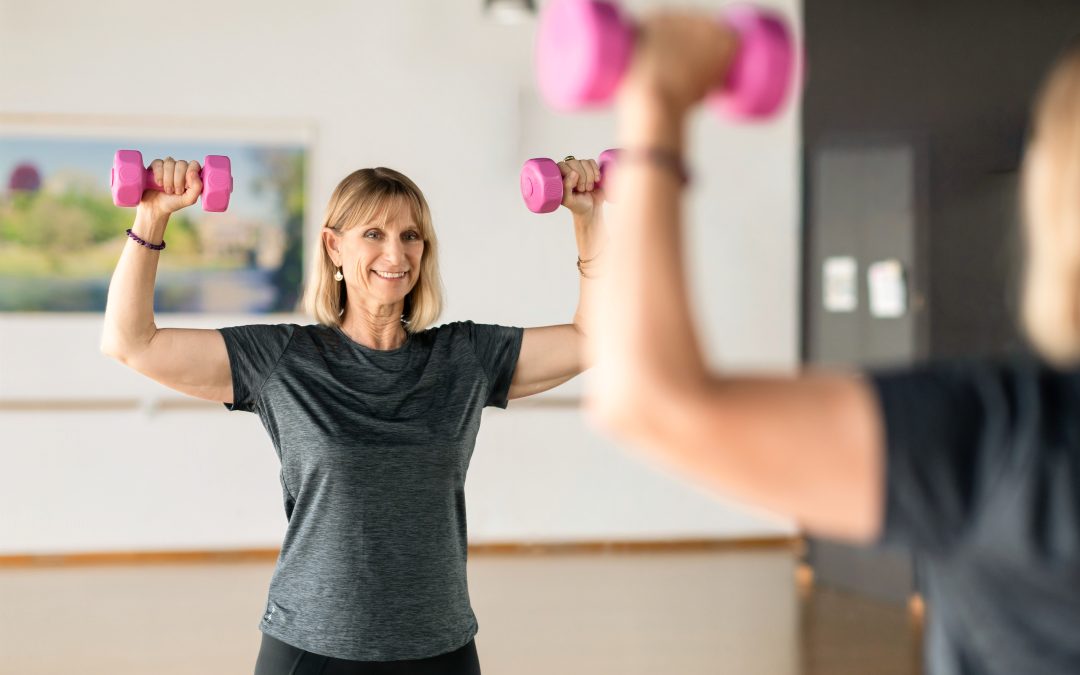
For a long time, like many women, I thought about exercise mainly as a way to stay fit and avoid putting on weight.
My view has changed quite a lot over the years.
Of course, I still want to feel good in my body and in my clothes. But when I pick up my weights today, I also think about the woman I will be in 10 or 20 years.
Will I still be able to carry my suitcase? Get up from the floor easily? Walk for several hours? Travel? Keep practising yoga?
These things seem very ordinary when we can do them without thinking. But as we get older, they become something very precious: our independence.
This is one of the reasons strength training after 45 has become much more important in my own practice and in what I teach.
What happens to our muscles after 45?
We gradually lose muscle mass and strength as we get older. For women, the years around perimenopause and menopause bring hormonal changes on top of the normal ageing process.
We hear a lot about hot flushes, sleep, weight gain or changes around the belly during menopause. These are often the changes we notice first.
But there are other changes happening that we can’t necessarily see.
We can gradually lose muscle and strength, and bone loss can also accelerate around menopause.
I think this is important because a number on the scales tells us very little about how strong our body actually is.
The good news is that our muscles can still respond when we use them. We can build strength in our fifties, sixties and beyond.
This is why I believe strength training after 45 deserves a place alongside the other ways we take care of ourselves at midlife.
But I walk and do yoga, Isn’t that enough?
As a yoga teacher, this is an interesting question for me.
I love yoga. I also walk a lot, and I have no intention of giving up either of them because I now do more strength training.
They simply give me different things.
Yoga helps me with mobility, balance, body awareness and breathing. Walking gets me outside, keeps me moving and is also very good for my mind.
But if I want to maintain and develop my strength, I need to ask a little more of my muscles.
So I don’t choose between yoga, walking and strength training. I combine them.
I think this is particularly useful as we get older. We don’t necessarily need to find the one perfect form of exercise. Our bodies benefit from moving in different ways.
You don’t have to join a gym
The words “strength training” can be a little intimidating.
Some women immediately imagine a gym full of machines and people lifting very heavy weights.
It doesn’t have to look like that.
I use dumbbells and resistance bands, and many of the exercises I do can easily be done at home.
The important thing is to start from where you are.
For one woman, standing up from a chair without using her hands may already be a real strength exercise. Someone else might be ready to squat holding a weight.
Both are strength training.
We can learn to squat, push, pull and carry. We can work our legs, arms, back and core. Then, as we become stronger, we can gradually make the exercises a little more challenging.
This progression matters. If an exercise becomes very easy, our muscles need a new reason to adapt.
That doesn’t mean constantly pushing ourselves to exhaustion. Sometimes it can simply mean using a slightly heavier dumbbell or adding a little more resistance.
Strength training and our bones
Our bones are another reason I have become much more interested in strength training.
This is something I pay particular attention to in my work around menopause.
The decline in oestrogen around menopause can accelerate bone loss, and this can happen without us feeling anything at all.
Resistance exercise places a load on our muscles and bones, which is one reason it is recommended as part of looking after our musculoskeletal health as we age.
Of course, picking up a pair of dumbbells isn’t a magic solution for osteoporosis. Bone health is more complicated than that. Nutrition, general physical activity, lifestyle and individual medical factors all matter.
But strength training certainly has a place in the bigger picture.
And I find that understanding why we are doing these exercises changes the way we think about them.
Is it too late to start strength training after 50?
No.
I sometimes meet women who feel they should have started years ago.
Maybe they haven’t exercised for a long time. Perhaps they have never lifted a weight in their life. And when they see fitness videos online, they feel that kind of exercise isn’t for them.
But we don’t need to exercise like we did at 25.
And we definitely don’t need to copy someone else’s workout on Instagram.
We can start with the body we have today.
That might mean sitting down and standing up from a chair, doing simple resistance exercises, walking regularly and working on mobility.
Then we progress from there.
Some women will need exercises to be adapted, particularly if they have pain, an injury or a medical condition. There is no shame in starting slowly.
The aim isn’t to prove anything. It’s to become stronger from your starting point.
How often should women do strength training after 45?
Public health recommendations advise adults to do muscle-strengthening activities involving the major muscle groups on at least two days each week.
I think two sessions a week is also a realistic place to start for many women.
And they don’t necessarily have to last an hour.
I would much rather see someone do two manageable sessions every week for months than start an ambitious programme five days a week and give it up after three weeks because it doesn’t fit into her life.
Consistency matters.
So does recovery.
This is something I pay more attention to now than I did when I was younger. We have been told for years that getting fitter means doing more, sweating more and burning more calories.
I don’t think that is always helpful at midlife.
Our muscles need to be challenged if we want them to get stronger, but our bodies also need time to recover.
Both matter.
The exercises I find most useful
I like exercises that have a connection with the things we do in everyday life.
Getting up from a chair. Carrying shopping bags. Climbing stairs. Picking something up from the floor. Pushing and pulling.
A simple strength session can include squats or sitting and standing from a chair, resistance-band rows, wall push-ups, exercises with dumbbells and some work for the core.
Balance and stability are important too, particularly as we get older.
There doesn’t need to be a long list of complicated exercises.
Learning a few movements well and gradually progressing them can already make a real difference to the way we move and feel.
I’m preparing for my seventies
This is probably the biggest change in the way I think about exercise today.
Yes, I still like feeling toned. And I’m not going to pretend that how my body looks doesn’t matter to me at all.
But it isn’t my only motivation anymore.
I’m preparing for my seventies.
I want to keep travelling. I want to walk, practise yoga, carry my own things, climb stairs and get up from the floor easily.
None of us knows exactly what ageing will bring. There are things we simply cannot control.
But there are things we can do today.
For me, becoming stronger is one of them.
And somehow, I find that a much more motivating reason to exercise than fitting into a smaller pair of jeans.
Where to start
If you know you should probably do some strength training but have no idea where to begin, keep it simple.
You don’t need a perfect programme or lots of equipment.
Start with a few basic exercises. Learn how to do them properly. Use a level of resistance that is right for you and gradually progress when your body is ready.
Most importantly, find something you can actually keep doing.
Because we aren’t only exercising for the bodies we have today.
We’re also taking care of the bodies we hope to live in tomorrow.
I also write for Yellow
I first explored this subject as a Guest Expert for Yellow, an English-language platform focused on perimenopause and menopause.
Read my Yellow article: Why Every Woman Over 45 Needs Strength Training →


